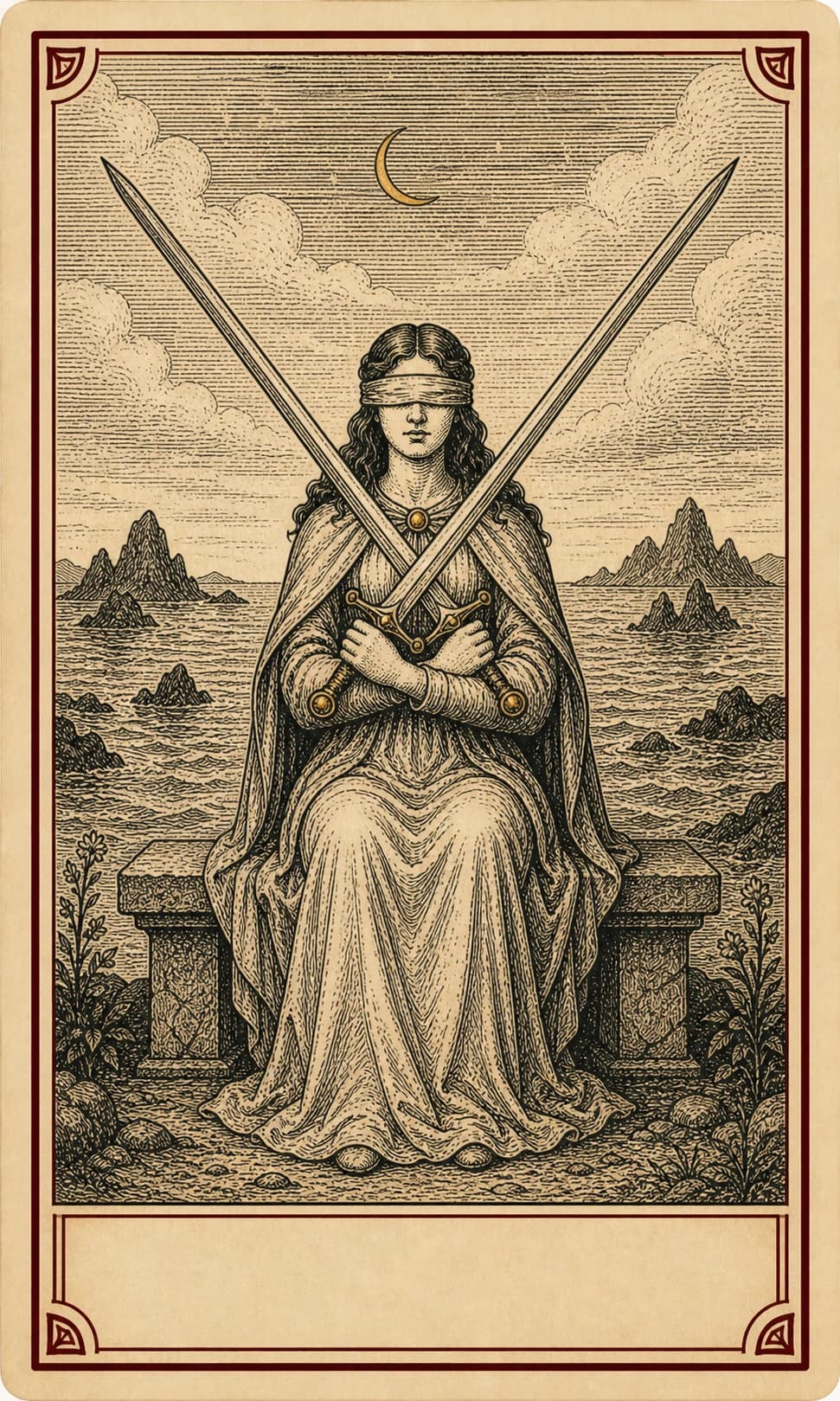
Two of Swords tarot card meaning
The Two of Swords holds two incompatible options in suspension while avoiding information or emotion that would force a choice.
Arcana: minor; suit: swords; rank: Two.
stalemate · difficult choice · avoidance
The Two holds competing positions in a temporary balance. A pause can prevent a premature reaction, but keeping both blades raised also takes effort. The reading asks what information or acknowledged feeling would allow the stalemate to become a considered decision rather than an indefinite defensive posture.
Upright meaning
The Two of Swords holds two incompatible options in suspension while avoiding information or emotion that would force a choice.
Create decision criteria, gather the missing fact, and set a reasonable point at which indecision must end.
Keywords: stalemate, difficult choice, avoidance
Reversed meaning
Reversed, the Two of Swords shows a stalemate breaking under too much information or becoming harder to deny.
Prioritize the facts that materially change the choice and accept that no option may remove all discomfort.
Keywords: information overload, exposed conflict, prolonged indecision
Put the card in position
Two of Swords in a reading
Love and relationships
Upright: Silence may prevent immediate conflict but cannot create mutual agreement; communicate the decision boundary.
Reversed: An avoided disagreement may now be visible; focus on a bounded decision rather than reopening every past issue.
Use the relationship spreadCareer and work
Upright: Identify the unresolved criterion behind a stalled decision. Ask the relevant person for the one fact or priority that would distinguish the options instead of requesting another general opinion.
Reversed: The apparent truce may already be costing time or trust. Acknowledge the conflict directly and make a limited decision where the evidence is sufficient, leaving only the genuinely uncertain part open.
Use the career spreadDecisions
Upright: Use the pause to compare the options fairly. Write the advantage and cost of each, then name what you have been unwilling to look at.
Reversed: If avoiding discomfort has become the deciding factor, bring that into the open. A choice can remain imperfect without needing to stay permanently unmade.
Use the decision spread