Sources and editorial references
Tarot19 uses historic texts, museum catalogues, modern scholarship, and institutional cultural records to document card meanings and traditions.
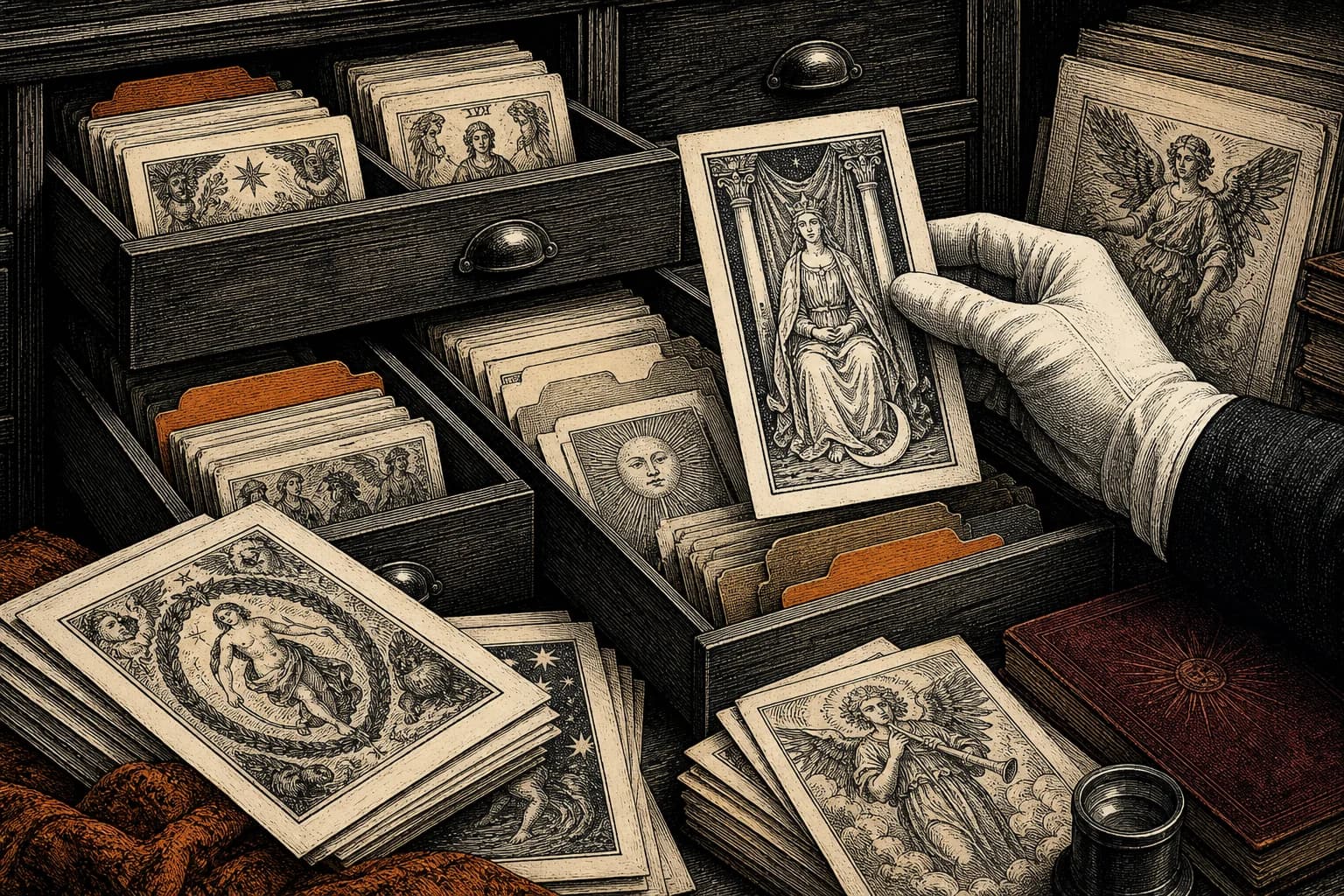
Primary and public-domain material
A. E. Waite's text, first published in 1910 and consulted here in its 1911 edition, documents a widely used set of card meanings and the Celtic Cross. Crowley's 1909 correspondence tables document the Golden Dawn attributions used as a secondary study lens. Historic museum records help verify surviving decks, dates, makers, and the material history of tarot cards.
Historical scholarship
Research by Michael Dummett, Ronald Decker, Thierry Depaulis, and other historians distinguishes the early card game from later occult and divinatory systems.
Modern interpretation
Modern scholarship on symbolism and reading practice provides context for terminology, spread structure, and the development of card meanings.
Cultural and health boundaries
Institutional folklore collections support contextual discussion of traditions without flattening them into one system. Public sleep-health education supports the boundary between dream reflection and qualified assessment.
Deck artwork and editions
Card text and artwork can have separate authors, dates, and rights. When comparing editions, check the specific image source and attribution as well as the accompanying text.
Source catalog
- The Tarot School, Determining Your Birth Cards.
- Role: Date-number reduction, implied pair and the 19/10/1 exception used by the birth-card calculator.
- Access: Consulted reference; no full text linked
- Golden Dawn, Book T, attributed to MacGregor Mathers and Harriet Felkin, attribution table, printed pages 4–5.
- Role: Primary table checked for all 36 numbered-card planet/sign correspondences. Used for factual attribution checks; the card applications and image descriptions are original Tarot19 writing.
- Access: Consulted reference; no full text linked
- A. E. Waite, The Pictorial Key to the Tarot (first published 1910; consulted in the 1911 edition).
- Role: Historical card titles, traditional divinatory vocabulary, and the documented Celtic Cross layout in the linked public-domain transcription.
- Access: Public-domain edition
- Michael Dummett, The Game of Tarot (1980).
- Role: Historical context for tarot as a card game and the later development of occult interpretation.
- Access: Consulted reference; no full text linked
- Ronald Decker, Thierry Depaulis, and Michael Dummett, A Wicked Pack of Cards (1996).
- Role: Editorial reference for the history of occult tarot and systems of correspondence.
- Access: Consulted reference; no full text linked
- Robert M. Place, The Tarot: History, Symbolism, and Divination (2005).
- Role: Editorial reference for symbolism, reading practice, and historical distinctions.
- Access: Consulted reference; no full text linked
- Aleister Crowley, 777 (1909).
- Role: Public-domain reference for Golden Dawn attributions, decans, court elements, and the Tree of Life correspondence system used in Tarot19 study notes.
- Access: Public-domain edition
- The British Museum collection records for historic tarot and tarocchi cards.
- Role: Institutional reference for surviving cards, dates, makers, and material history.
- Access: Institutional collection or public guidance
- Library of Congress research guides and collections for folklore and traditional culture.
- Role: Editorial context for documenting beliefs, practices, and living traditions with attention to their specific sources.
- Access: Institutional collection or public guidance
- American Academy of Sleep Medicine public education materials about dreams and sleep health.
- Role: Reference for connecting dream journaling with sleep-health information and directing persistent sleep concerns to qualified care.
- Access: Institutional collection or public guidance