How to read tarot cards
A useful tarot reading combines a clear question, a spread chosen in advance, card meanings read in position, and honest comparison with real circumstances.
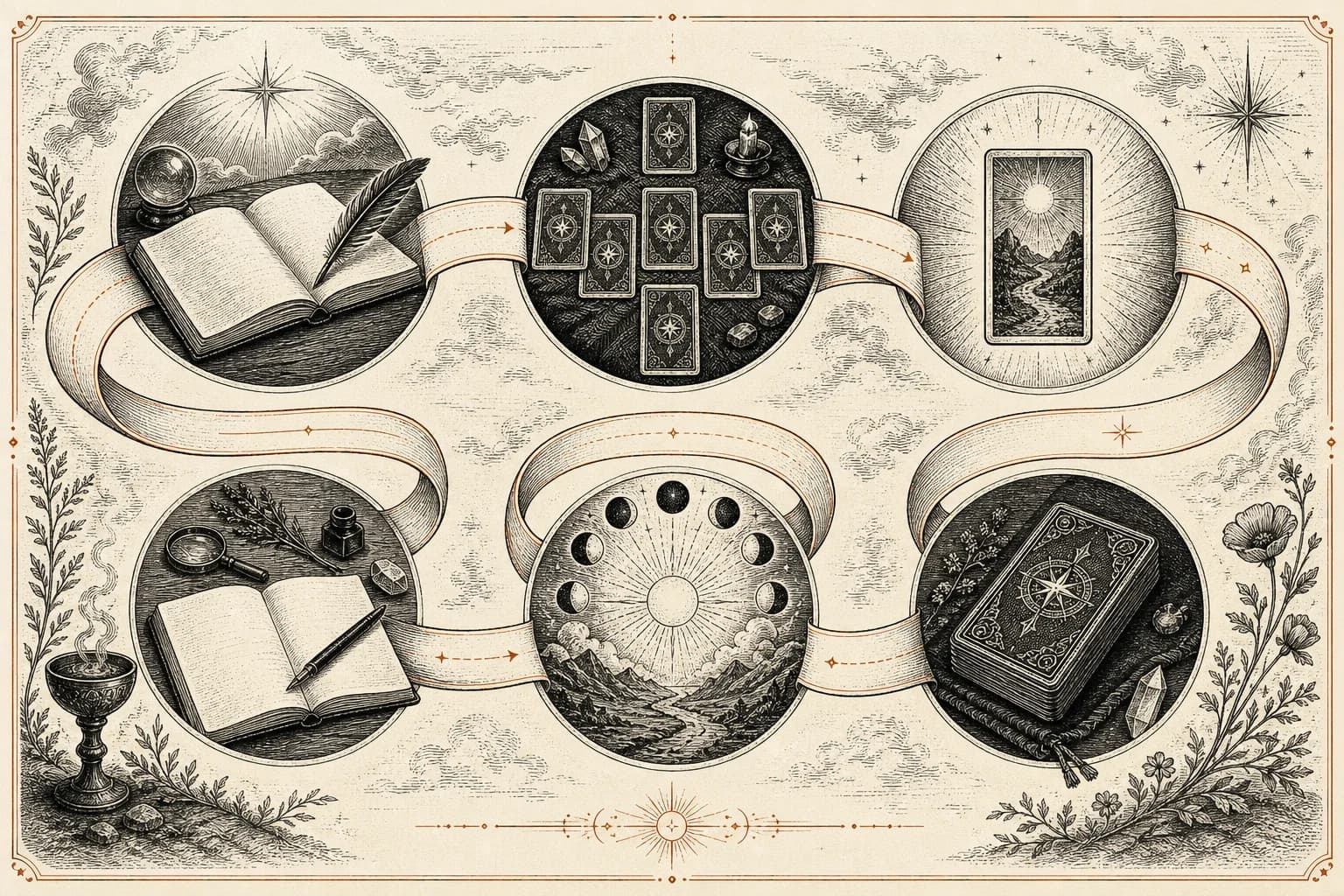
Begin with a purpose
Decide what you want from the reading before drawing. You might want to identify a tension, compare possible approaches, or notice what you have overlooked. A defined purpose makes it easier to choose the interpretation that best fits the position and context.
Frame an open question
Questions about your own choices work better than attempts to uncover another person's private thoughts. Prefer “What should I consider before I respond?” over “What will they definitely do?” and omit private detail that the reading does not need.
- Ask about a present choice, pattern, need, or assumption.
- Leave room for more than one interpretation or outcome.
- Keep consent, safety, diagnosis, guilt, and financial facts with direct information and conversation.
Choose the spread before drawing
A spread assigns a question to each position. One card provides a focus; three cards create sequence or contrast; a relationship spread separates perspectives; the Celtic Cross maps a broad situation. Choose the smallest structure that can address your purpose.
Read each card in its position
Start with the card's core theme, then narrow it through the position label. The same card can emphasize an obstacle in one position and an available resource in another. Write one sentence for each card before trying to connect the spread.
Treat reversals as another lens
A reversed card may suggest resistance, delay, excess, shortage, or an inward form of the upright theme. It is not automatically negative. If reversals make a reading less clear, disable them and use position plus context instead.
Synthesize and close
Look for repetition, contrast, and movement across positions. Separate what is directly known from what is symbolic, then choose one reflection question or proportionate action. Record the reading before drawing again so you do not chase a preferred answer.
- Summarize each position in one grounded sentence.
- Mark interpretations that depend on assumptions rather than known facts.
- Choose one question, conversation, or reversible next step.
- Write down the information or conversation needed for the next step.