How to read tarot card combinations
Cards change emphasis through their spread positions, orientation, order, shared imagery, and the reader's question. A repeatable synthesis method connects those details more clearly than memorizing thousands of fixed pairs.
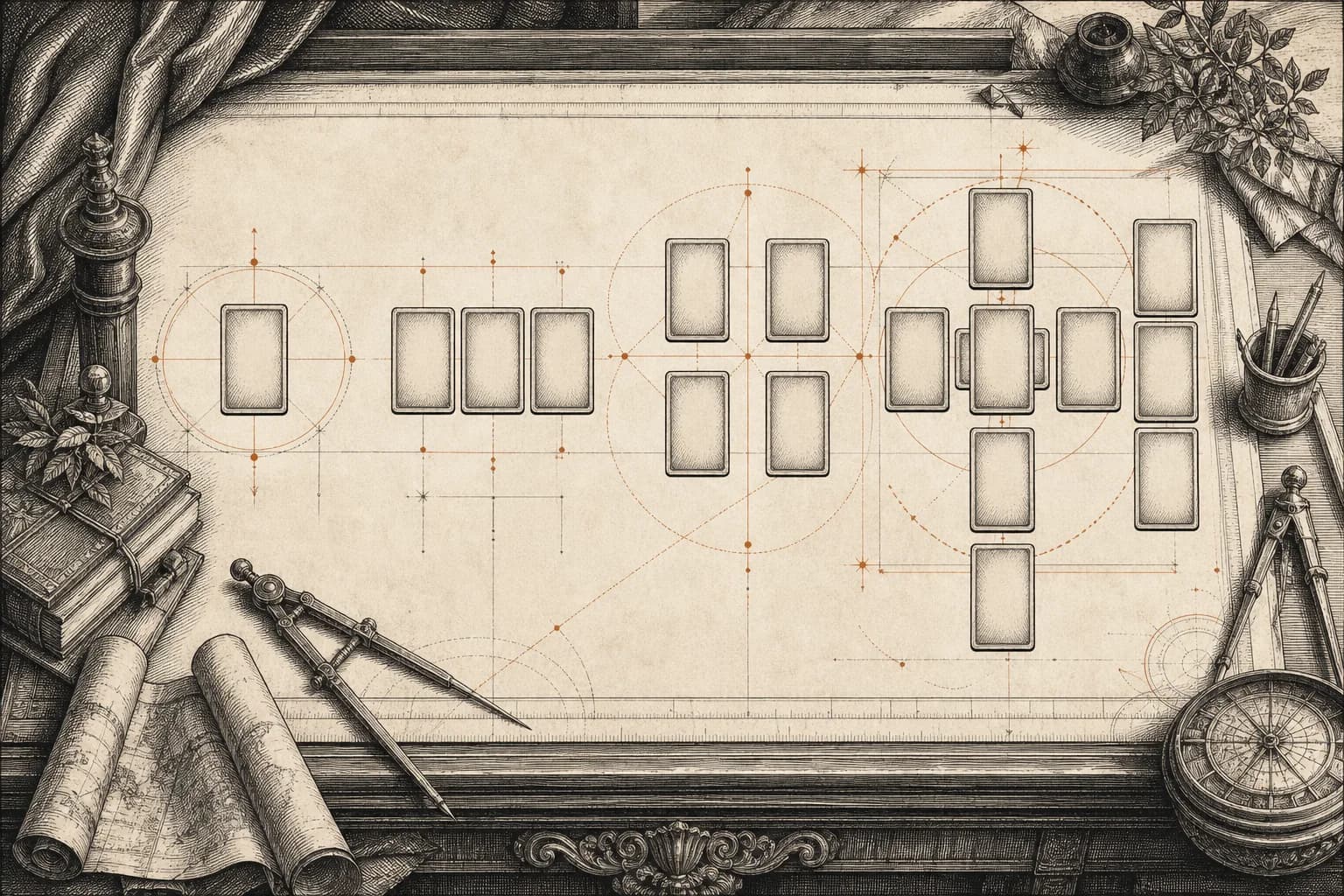
Read each card in position first
Write one grounded sentence for every card before joining them. Include the position label, the card's core theme, and the detail that seems most relevant. This prevents a dramatic neighbouring card from erasing the job assigned to the first position.
Look for repetition and concentration
Repeated suits, numbers, court ranks, or themes can show where the spread places emphasis. Several Cups may concentrate emotional material; several Fives may highlight disruption or adjustment. Use that repetition to sharpen the reading's central question.
Notice contrast between cards
Cards may pull in different directions: movement beside rest, openness beside protection, or analysis beside feeling. Instead of deciding that one cancels the other, ask whether the spread describes competing needs, different stages, or a tension that requires balance.
Follow order and sequence
In past-present-direction or situation-challenge-guidance layouts, order supplies grammar. Describe what changes from one position to the next. Use words such as while, because, but, and therefore to build a sentence around the direction the spread suggests.
Use a three-sentence synthesis
First state the strongest shared theme. Second name the most useful contrast or unresolved question. Third choose a reflection prompt or reversible next step, including any relevant conversation or information.
- The spread repeatedly draws attention to…
- The main tension or difference is…
- A question or small next step worth considering is…
Skip fixed pair dictionaries
A fixed two-card phrase ignores spread position, orientation, question, and deck tradition. Use examples to practise the method, then build each combination from the cards' actual positions and shared details.