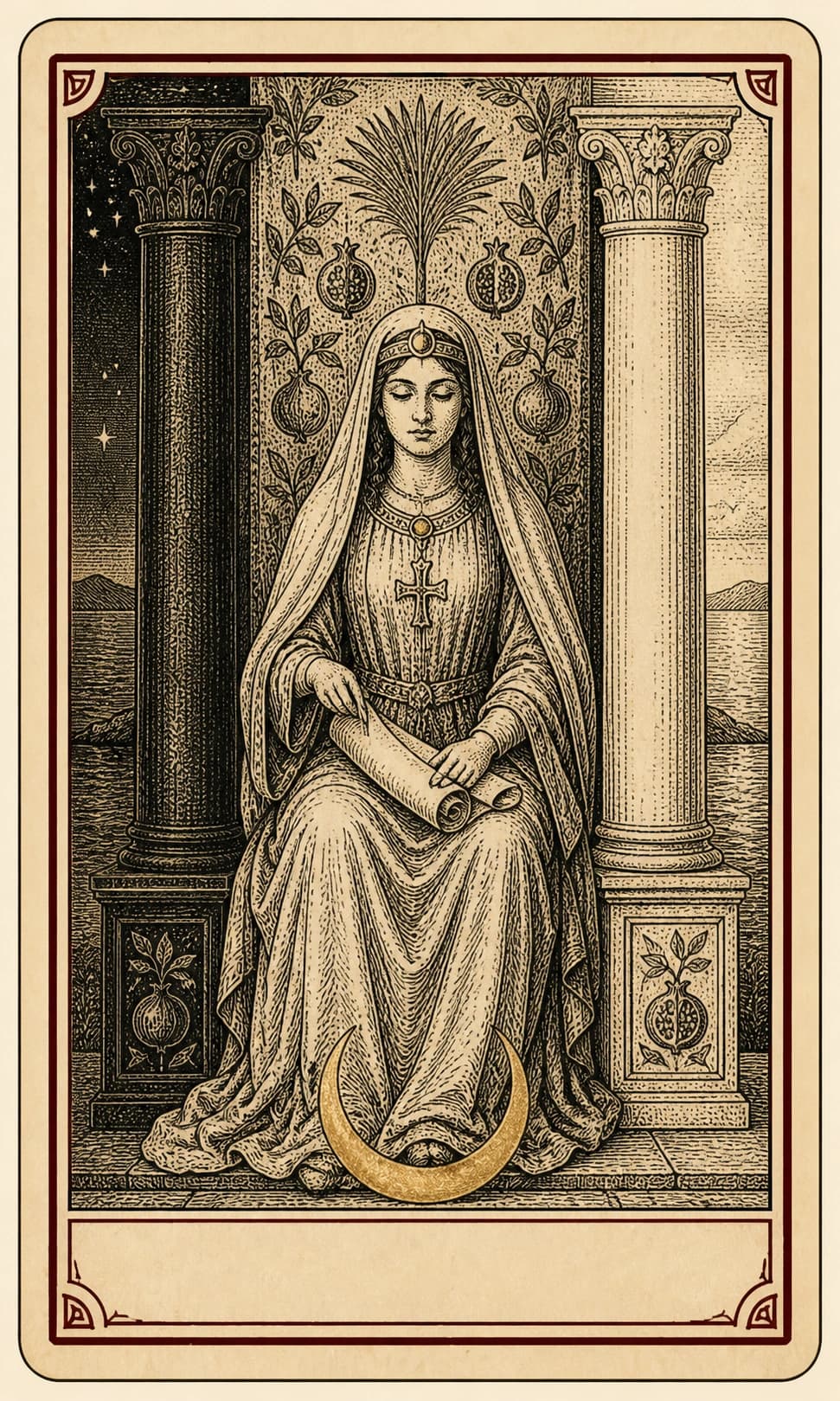
The High Priestess tarot card meaning
The High Priestess asks for quiet attention to information that is subtle, incomplete, or still forming.
Arcana: major.
intuition · receptivity · inner knowledge
At II, the High Priestess interrupts the Magician's outward act with attention to what is not yet clear. She does not supply missing facts by guessing. Her place before the Empress makes room for an idea or feeling to develop privately before it is expressed, shared or cultivated in the world.
Upright meaning
The High Priestess asks for quiet attention to information that is subtle, incomplete, or still forming.
Pause before forcing a conclusion; observe bodily signals, patterns, and uncertainty while checking intuition against facts.
Keywords: intuition, receptivity, inner knowledge
Reversed meaning
Reversed, The High Priestess suggests a weak connection to inner signals or secrecy that blocks understanding.
Noise, anxiety, or wishful thinking may be mistaken for intuition; return to observable information and patient reflection.
Keywords: ignored intuition, secrecy, disconnection
Put the card in position
The High Priestess in a reading
Love and relationships
Upright: Make room to listen without assuming silence reveals another person's thoughts; privacy and direct questions still matter.
Reversed: Withholding important information can erode trust, while demanding disclosure can violate boundaries; seek a respectful middle ground.
Use the relationship spreadCareer and work
Upright: Listen before announcing a conclusion. A quiet colleague, an unexplained inconsistency, or a question nobody has asked may deserve attention. Keep a note of what you notice, then separate the observation from the interpretation you are placing on it.
Reversed: Secrecy or excessive interpretation may be obstructing ordinary communication. Ask for the information you need and distinguish confidential material from something merely unclear. Do not treat a strong hunch as a verified explanation of workplace behaviour.
Use the career spreadDecisions
Upright: Allow the unspoken part of your response to become articulate. Write down the attraction and hesitation without forcing an immediate verdict, then identify which uncertainty calls for reflection and which calls for a factual answer.
Reversed: If repeated inward searching keeps producing contradictory signs, return to a concrete criterion. Your preference matters, but a choice also needs terms you can explain and evidence you can inspect.
Use the decision spread