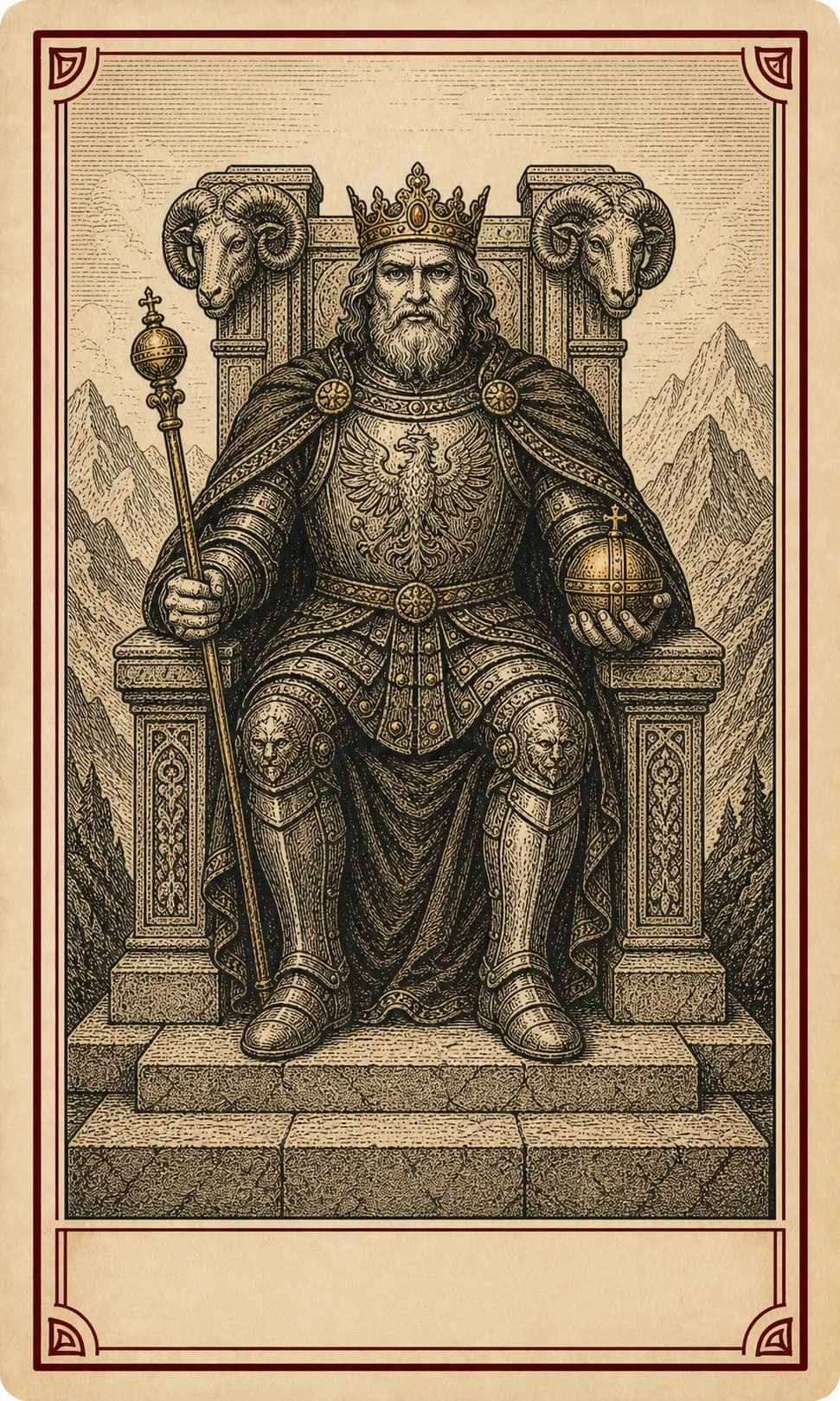
The Emperor tarot card meaning
The Emperor concerns the rules, boundaries, and accountable leadership that make a situation dependable.
Arcana: major.
structure · responsibility · stable authority
The Emperor is Major Arcana IV. After The Empress creates the conditions for growth, The Emperor gives that growth boundaries, roles, and durable form; before The Hierophant turns order into a shared tradition, IV asks whether personal authority can make stable, accountable decisions.
Upright meaning
The Emperor concerns the rules, boundaries, and accountable leadership that make a situation dependable.
Define responsibilities and decision criteria clearly, then use authority to create stability rather than merely display control.
Keywords: structure, responsibility, stable authority
Reversed meaning
Reversed, The Emperor shows structure hardening into control or leadership that lacks real stability.
Rules may be serving the rule-maker rather than the shared purpose; test whether flexibility and distributed responsibility would work better.
Keywords: rigidity, domination, unstable authority
Put the card in position
The Emperor in a reading
Love and relationships
Upright: Healthy structure can protect trust, but agreements should remain mutual and open to review rather than imposed unilaterally.
Reversed: Control, intimidation, and unilateral decisions are not signs of security; preserve consent and seek support where safety is affected.
Use the relationship spreadCareer and work
Upright: In a career reading, The Emperor calls for clear ownership, realistic standards, and a structure people can rely on. Define who decides, what success means, and which boundaries protect the work, then use authority to remove ambiguity rather than to display rank.
Reversed: The structure may be rigid, inconsistently enforced, or dependent on one person's control. Look for rules that protect status instead of the work, unclear accountability behind forceful direction, or leadership that will not accept useful challenge.
Use the career spreadDecisions
Upright: Choose by setting the non-negotiable constraints first: responsibility, resources, timing, and who bears each consequence. The Emperor favours the option that can be governed by explicit criteria and supported after the initial decision.
Reversed: Ask whether control is being mistaken for certainty. A reversed Emperor can show an overruled stakeholder, a rule applied only when convenient, or reluctance to own the decision; restore accountability before committing further.
Use the decision spread