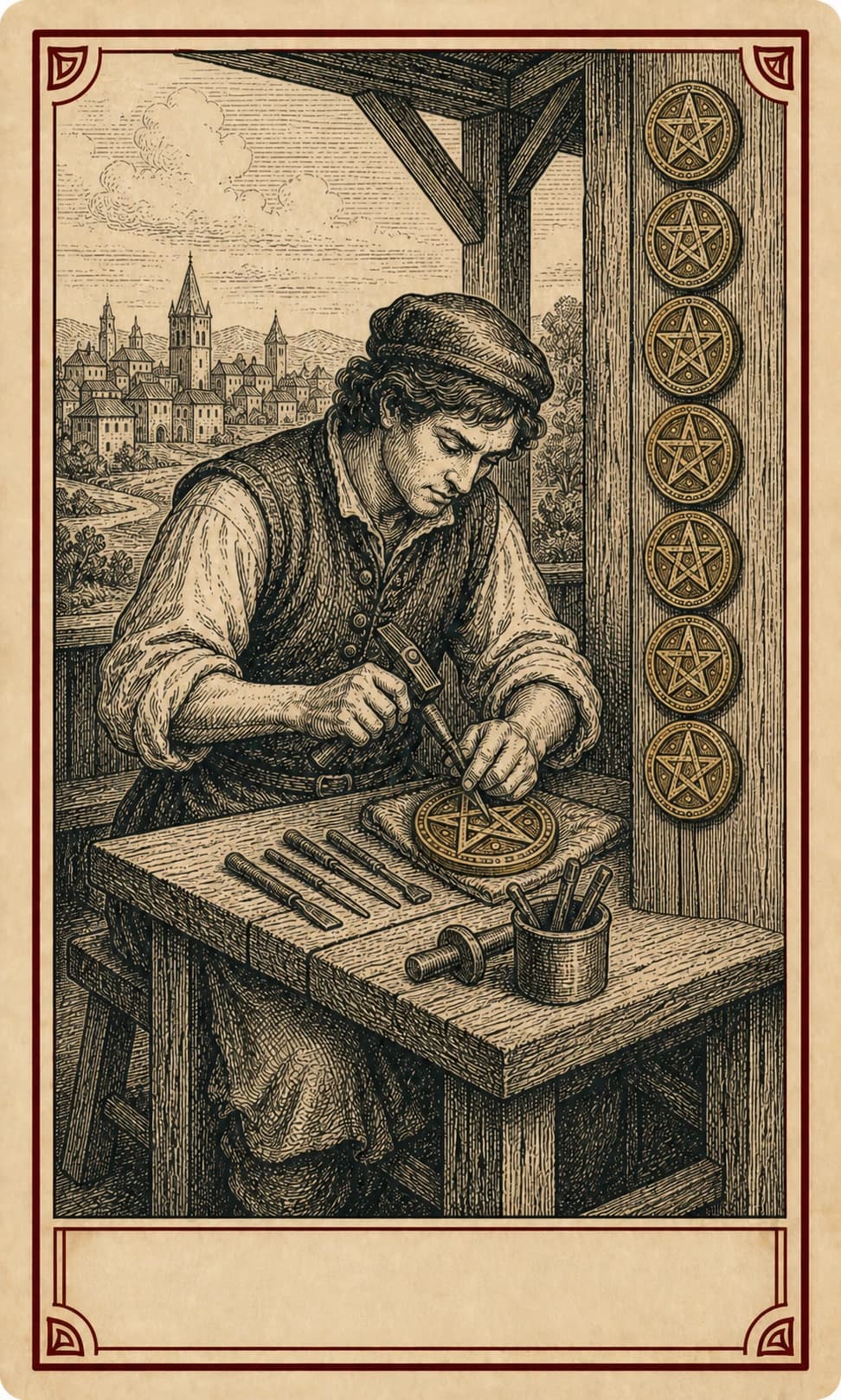
Eight of Pentacles tarot card meaning
The Eight of Pentacles develops competence through repetition, attention to detail, and willingness to correct small errors.
Arcana: minor; suit: pentacles; rank: Eight.
skill-building · diligence · apprenticeship
The Eight concentrates Pentacles into craft. Improvement comes from repeating a task with enough attention to notice differences, not from repetition alone. The visible series of work gives the learner a record against which the next attempt can be judged and refined.
Upright meaning
The Eight of Pentacles develops competence through repetition, attention to detail, and willingness to correct small errors.
Choose a practice that produces feedback and improve one component at a time instead of performing expertise prematurely.
Keywords: skill-building, diligence, apprenticeship
Reversed meaning
Reversed, the Eight of Pentacles shows repetition without learning, neglected quality, or perfectionism that prevents completion.
Restore feedback, define an adequate standard, and confirm that the skill being practiced still serves the goal.
Keywords: perfectionism, poor quality, misdirected practice
Put the card in position
Eight of Pentacles in a reading
Love and relationships
Upright: Trust can be built through repeated reliable behaviour; grand gestures cannot substitute for everyday practice.
Reversed: Repeated promises without changed behaviour are not practice; focus on one observable relational habit.
Use the relationship spreadCareer and work
Upright: Choose the particular technique that needs practice and arrange feedback on successive attempts. A smaller well-defined exercise can improve the real work more than another broad promise to become better.
Reversed: Repetition may have become automatic or perfectionism may prevent delivery. Identify the standard the task actually needs and correct the specific recurring weakness rather than endlessly polishing everything.
Use the career spreadDecisions
Upright: Prefer the option whose required skill you are willing to practice. Ask what the regular work looks like after the initial motivation has faded.
Reversed: If the choice depends on a skill you do not yet have, make the learning requirement explicit. Neither confidence nor self-criticism replaces an observable practice plan.
Use the decision spread